A calm mind is not built through the absence of tensions — internal or external. It is built through the ability to stay organized in spite of them. Thoughts, emotions, and stimuli are simply part of being human — what changes isn’t whether they show up, but how the mind processes them.
In that sense, mental balance is our own masterpiece: forever unfinished, in an ongoing process of adjustment. Internal noise doesn’t need to disappear for balance to exist; it needs to be absorbed, organized, and integrated into the systems that keep the body working in harmony.
This is the context in which a calm mind stops being an abstract ideal and becomes a functional capacity — an expression of ongoing neural regulation, and of resistance to outside pressures taking control of the systems responsible for internal balance.
A state of physical comfort emerges when the body sustains balance, resilience, and natural ease in movement.
Physical comfort reflects the body’s ability to regulate inflammatory responses and return to balance after periods of demand.
Sustaining a calm mind has less to do with resisting stimuli and more to do with staying balanced in spite of them. At the center of this dynamic is the Endocannabinoid System — our biological architect, responsible for harmonizing responses and internal signals, making the body’s balance its great masterwork.
Cannabinoids — both those the body produces on its own and those derived from Cannabis — are part of how this architecture works. They take part in modulating the processes that shape how we handle stress, how we process emotion, and how we enter deep states of recovery.
It’s through this interaction that the system keeps its capacity to adapt. When regulatory mechanisms work in an integrated way, the body can respond to pressure without falling into disorder, process experience without letting it build up, and recover without balance being compromised over time.

Rather than acting on symptoms one by one, cannabinoids interact with this regulatory system, taking part in the modulation of processes involved in stability, adaptation, and the return to balance even as things keep changing. Together, this comes down to the ability to withstand stress without collapsing, to process emotion without letting it accumulate, and to recover in a deep and consistent way.
A calm mind is the result of a dynamic, complex balance where stress, emotion, and sleep coexist — elements that sometimes conflict, yet remain deeply intertwined. That’s simply how the architecture of balance works: it’s always under construction.
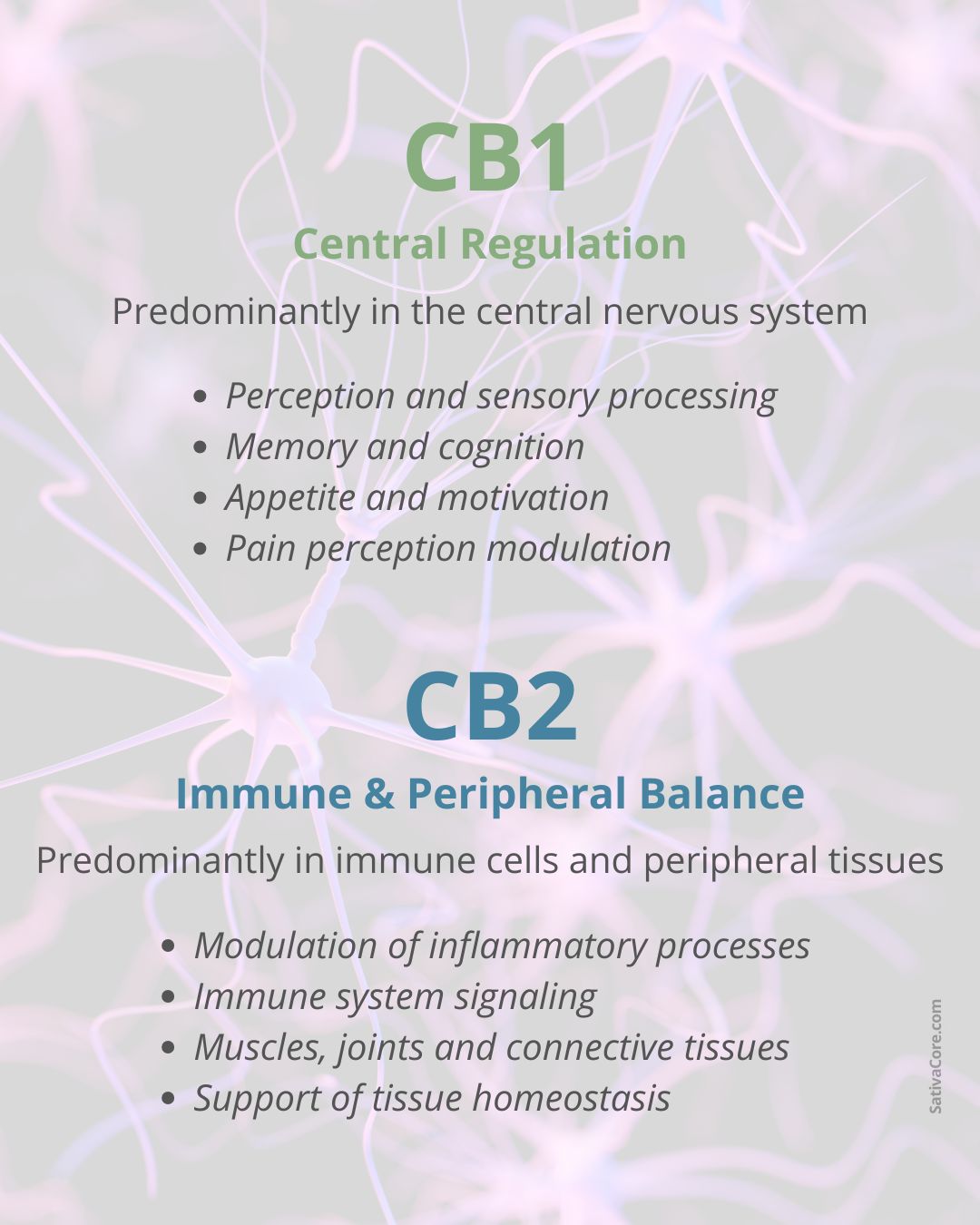
The Endocannabinoid System and its primary receptors: CB1 and CB2.
The architecture of Calm Mind rests on three dimensions:
Stress Tolerance
The ability to absorb pressure without it turning into lasting overload depends on the integrity of the systems that regulate that response over time.
Emotional Balance
Emotions, when processed rather than accumulated, fulfill their original function — to signal, react, and move on.
Restorative Sleep
Recovery happens more fully when the body is able to slow down and complete, on its own, the processes that sustain rest.
SativaCore’s recommendations are independent and guided by transparent evaluation criteria. We collaborate with brands committed to third-party laboratory testing (Certificates of Analysis, or COAs), clear labeling practices, and responsible manufacturing standards for hemp-derived formulations. Below are the partners whose practices align with our commitment to physiological balance and informed choice.
Content may be shared or reproduced provided that the original source is credited with a direct link to sativacore.com