

Persistent discomfort can reshape everyday life without anyone quite noticing, limiting movement and the energy available for even the simplest tasks. Most people only start looking for answers once that discomfort has become routine. But the human body wasn’t built for constant immobility, nor for continuous overload.
Yet modern life often pushes us toward both extremes. Prolonged static posture, repetitive physical strain, persistent stress, and the natural aging process all activate inflammatory responses that are part of the body’s adaptive mechanisms.
In this context, inflammatory balance is about how the body regulates these signals over time, favoring comfort without suppressing natural adaptation. These processes are directly tied to how the body experiences physical discomfort, sustains joint function, regulates metabolic balance, and modulates immune responses.
Feeling physical discomfort is, more often than not, a form of communication: the body signaling that it needs adjustment, rest, or functional reorganization.
Discomfort is the body’s way of asking for help. Read it.

A state of physical comfort emerges when the body sustains balance, resilience, and natural ease in movement.

Physical comfort reflects the body’s ability to regulate inflammatory responses and return to balance after periods of demand.
When we speak of physical comfort and inflammatory balance, we are not referring simply to the immediate reduction of discomfort. For many people, the search begins with relief — but long-term comfort depends on regulation, not suppression.
In a functional sense, comfort involves a gradual process through which the body returns to a state of balance following periods of overload or excessive strain.
Sustainable physical comfort emerges when multiple systems operate in coordination — not when these natural processes are interrupted or suppressed. For this reason, contemporary approaches focused on bodily balance — outside of emergency contexts — aim to support the body’s physiological mechanisms rather than replace them or foster ongoing reliance on synthetic interventions.
The human body operates in a continuous state of adjustment to preserve its internal balance—a process known as homeostasis. To sustain this balance, the body itself produces molecules known as endocannabinoids—primarily anandamide (AEA) and 2-arachidonoylglycerol (2-AG). In other words, even as you read these lines, your body continues to produce and break down these cannabinoids as part of its ongoing self-regulatory processes.
If the body produces cannabinoids, it is because its cells are prepared to recognize and respond to them. The assimilation of these molecules occurs through specific receptors known as CB1 and CB2.
CB1 receptors are more abundant in the central nervous system, while CB2 receptors are found predominantly in the immune system and in tissues related to the body’s defense mechanisms—particularly those involved in the modulation of inflammatory processes that influence physical comfort and the body wellness.
This intrinsic regulatory network forms the biological foundation within the scope of body wellness, this regulatory network is reflected in four interconnected dimensions: the experience of physical discomfort, joint function and mobility, metabolic balance, and immune modulation. Together, these processes shape how the body adapts, recovers, and sustains physical resilience over time.
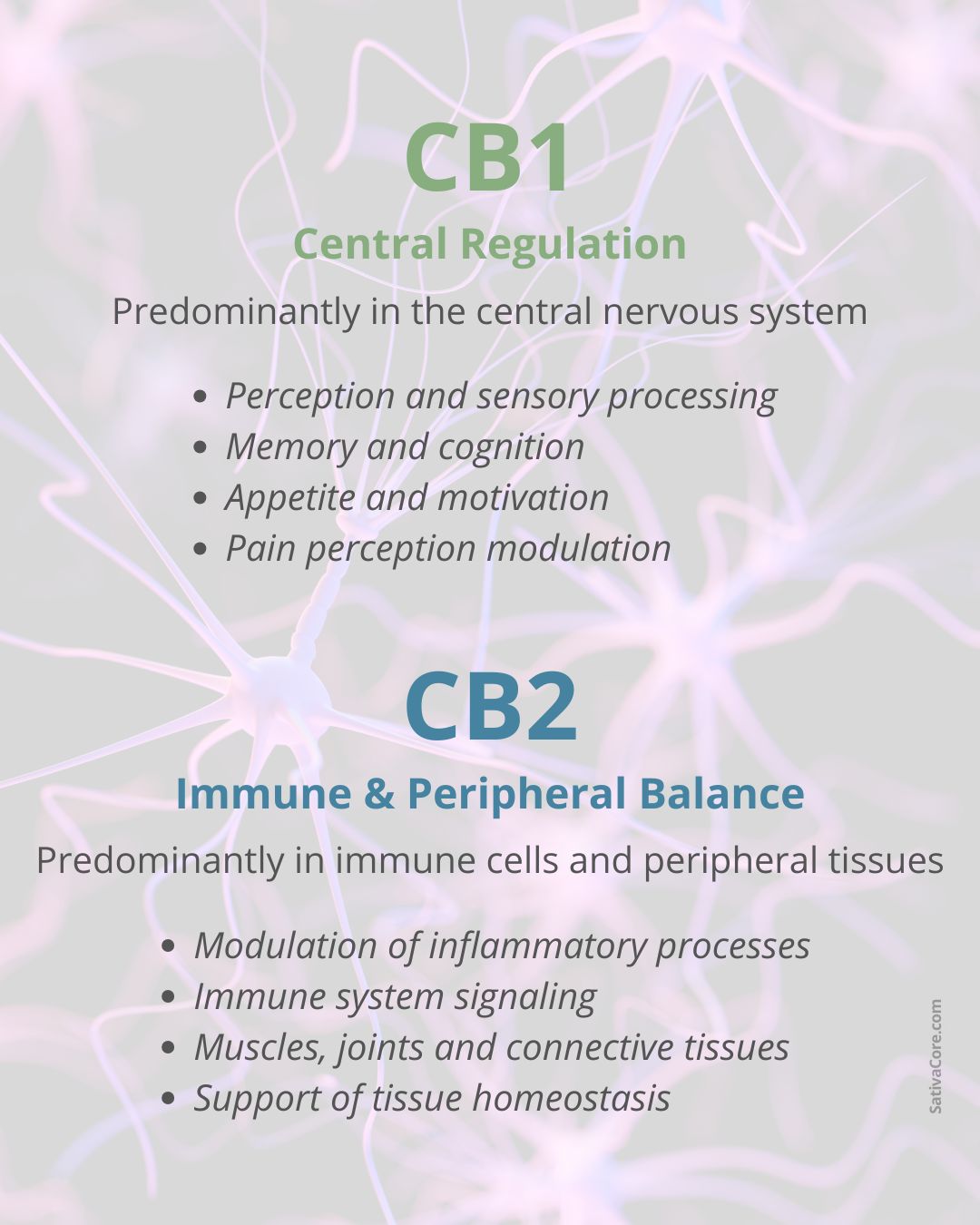
The Endocannabinoid System and its primary receptors: CB1 and CB2.

Beyond endogenous regulation, the interaction between humans and Cannabis sativa has also shaped scientific and cultural perspectives over centuries. When this complex biochemical balancing network — the Endocannabinoid System — functions in an integrated manner, the body tends to moderate the intensity of inflammatory responses. However, this balance is not always easily maintained. Aging, lifestyles marked by extremes of physical and emotional demand — ranging from chronic stress to sedentary habits and unbalanced nutrition — can make it more difficult for the body to return to its natural states of mobility, comfort, and equilibrium.
It is within this context of disrupted bodily balance that phytocannabinoids have been studied for their interaction with this regulatory network, supporting mechanisms that, under ideal conditions, the human body is able to regulate on its own. The supplementary contribution of these compounds to biochemical balance has proven so significant that Cannabis sativa — a plant with a high concentration of these molecules — has been described by Brazilian biologist and neuroscientist Sidarta Ribeiro (University of Brasília, Federal University of Rio de Janeiro, Rockefeller University, and Duke University) as “man’s best friend.”
Ribeiro uses the metaphor of a “botanical dog” to illustrate the coevolutionary relationship humanity has developed with the plant over thousands of years, comparable in his view to the bond formed with dogs through the domestication of wolves.
This deep historical relationship between humans and Cannabis sativa underscores a modern responsibility: ensuring that the phytocannabinoids we introduce into our regulatory systems are of the highest purity and consistency. As scientific understanding evolves, so too must the standards by which these botanical compounds are selected.
Contemporary research and editorial perspectives on botanical wellness have increasingly focused on specific phytocannabinoids — particularly cannabidiol (CBD) and cannabigerol (CBG) — due to their interaction with CB2 receptors within the Endocannabinoid System.
Acknowledging the cross-contributions of dozens of cannabinoids through what is known as the entourage effect, CBD and CBG are widely studied for their interaction with inflammatory response systems and mechanisms involved in physiological balance, especially in relation to peripheral tissues, joint function, and immune signaling associated with physical comfort.
Rather than replacing the cannabinoids naturally produced by the body, these compounds are understood to participate in a functional dialogue with existing regulatory pathways, including those involved in the modulation of inflammatory processes and physical discomfort. These interactions are particularly relevant in contexts involving joint stress, metabolic imbalance, and immune system signaling.
For this reason, factors such as extraction purity, molecular stability, and bioavailability become particularly relevant when botanical compounds are selected in alignment with the body’s regulatory systems. The effectiveness of phytocannabinoids in supporting physiological balance is intrinsically linked to the quality of the source material — which is why SativaCore prioritizes partnerships with brands that demonstrate verifiable commitment to pharmaceutical-grade standards, including full-panel third-party testing and transparent sourcing. By ensuring these high standards, we sustain the biological foundations of Body Wellness and long-term physical resilience.
“The answers are in nature;
asking the right questions is our task.”
— An ecological perspective
Body wellness is expressed through distinct but interconnected dimensions of the body’s function. Explore each to understand how balance is sustained in practice.

Metabolic Balance
Sustain energy and internal balance through regulated physiological processes.

Immune Modulation
Maintain balance through adaptive immune responses and natural defense systems.

SativaCore’s recommendations are independent and guided by transparent evaluation criteria. We collaborate with brands committed to third-party laboratory testing (Certificates of Analysis, or COAs), clear labeling practices, and responsible manufacturing standards for hemp-derived formulations. Below are the partners whose practices align with our commitment to physiological balance and informed choice.

Content may be shared or reproduced provided that the original source is credited with a direct link to sativacore.com